Posts

Get English Sewing in the 20th Century

Image
 I have a new book available to purchase in the following ways:  Amazon Kindle- £2.99  https://amzn.eu/d/dPZ4Xae Amazon Paperback - £5.99   https://amzn.eu/d/5mJjhFp Etsy pdf download -£3.59  https://www.etsy.com/uk/listing/4375786566/english-sewing-in-the-20th-century-a Here's the blurb: The English Sewing Cotton Company was established in 1897, and brought together a combine of 14 major cotton producing companies. Household names such as Dewhurst's (the makers of the Sylko cotton reel), Arkwright of Cromford, Strutts of Belper and Ermen & Roby were among the members. Over the following 80 years, the fortunes and marketing of the English Sewing Cotton Company reflected the way that women throughout the country sewed. This short history looks at how the English Sewing Cotton Company worked, and at the peak and decline of domestic sewing. From fancy needlework competitions to visiting needlewomen, this book follows the thread of sewing in the 20th centur...

World War Two and the ESCC

Image
The Executive Committee minutes from the early years of WW2 reflects a sense of minor panic. A war emergency stock of Sylko Machine Twist was set up, with 13,000 gross of finished goods being set aside. The stock was stored in Belper, hopefully off the Luftwaffe's radar. They weren't so sure about the safety of storing it in Manchester - rightly so. In October 1940 a roof spotter was appointed to watch out for incendiaries landing on Arkwright House.  But there were also reports of a slackening off in the quality department.  In August 1940, the Committee declared themselves to be disappointed with the poor lustre of the Sylko samples. Earlier in the year, badly centred tickets were a cause for concern, and the issue of faulty ticketing also reared its head again in October.  But the company recovered from early panic due to the ongoing need for large amounts of thread for the war effort. Belper produced khaki fabric for the army and upholstery thread for Austin Motors wh...

A Second Visit to the Archives

Image
 I made a second visit to the Manchester Archives to view some more of the English Sewing Cotton Company material. It is a huge archive and it's difficult to know what to choose to look at - which documents will hold the most information? There are no previews online - just a list of what the archive contains. This time around, I decided to view some meeting minutes. There are Directors' Minutes and Executive Committee Minutes for practically the whole of the life of the ESCC.  Too much to see all at once. Again - it's difficult to know what to select because there is no indication of the size of each item. In the end I selected one lot of Directors' Minutes and four lots of Executive Minutes. This did turn out to be too much - meetings were held very regularly and the books containing the typed sheets of notes were rather large. I was unable to do it all justice in the 3 hours I had at my disposal. However, I picked out a few snippets of information to bring away with ...

Label Discoveries

Image
As the English Sewing Cotton Company, latterly English Sewing Limited, developed over the decades of the 20th century, so did the labels on their Sylko reels. It seems impossible to pinpoint when exactly Sylko labels were subject to often tiny changes and how many differences there are in existance. One end of the reels hardly altered - the red, white and blue logo end with the 3 shells branding. Not until the Tootal years did anyone dare mess with this branding.  It the blue and white ends stating the colour shade and number have myriad differences. And even after years and years of collecting  - for me it must be more than a decade now - those little surprises keep on popping up. Here's a new one, discovered in an antiques shop in Hebden Bridge this week: I have never before seen that wording "Fast to B.S. 3418-61". On all other reels that I have, the label simply states "Fast Dye". See the reel here with others for comparison: I would say that the Blue Crest ...

Found Poetry, 1966

Image
  Crafting magazines in the late 60s were embracing man made textiles, emphasising the ease in which they could be turned into clothes, and the subsequent ease in which these garments could be cared for. Not that you needed to look after them that carefully, everything was so cheap you could just make another at the drop of a nylon zip. It had never been so easy to be in fashion.  

Found Poetry, 1952

Image
  From a 1952 needlework magazine, when ladies were encouraged to make their home as beautiful as possible using their skills. The aspiration was dainty with a slight French accent.

A Visit to Masson Mills

Image
 If you take a trip down the A6 south from Matlock, you can’t fail to miss Masson Mills. Built by Sir Richard Arkwright ‘s company in 1783, the cotton mill was deliberately constructed to stand out. Back then, the majority of Derbyshire buildings were constructed of local stone. Arkwright chose red brick for his new mill – a big sore thumb next to the Derwent. It showed off just how rich he had become on the proceeds of his cotton spinning. There is a ring attached to one of the internal walls which is reputedly where Arkwright tied his horse when he came to inspect the works. They say that if you touch it, you will become as rich as he was! Today, the mill buildings are a museum and heritage centre, and guided tours currently take place on Thursdays and Fridays. I decided to join one of these, as I thought it could be a source of ESCC information. Masson Mills became part of the ESCC combine when the grouping took place in 1897, and remained operational until 1991. I was very plea...

Found Poetry, 1956 and 1968

Image
  In 12 years sewing magazine articles went from antimaccassars to beach holidays abroad. Publishers caught up with what women really wanted from life - especially the young. We didn't want to be pretty and becoming so much as having fun with our hair loose. The similarities are that dressmaking projects needed to be quick and easy. By 1968 there were now easy care fabrics available too.

Workers in World War One

Image
In January 1916, conscription was introduced in order to obtain more front line troops for the trenches. As the war went on, such was the government's desperation to obtain more cannon fodder, the upper age limit was pushed up to 50!  Some occupations were protected and companies (as well as the individuals concerned) could appeal conscription for their workers if they could prove that their work was vital. In November 1917, The Derbyshire Advertiser published an item titled "Belper Tribunal". This was a report into the military tribunals that had taken place to decide whether local workers should be sent for military service. This being Belper, a town dominated by the mills established by the Strutt family, a lot of the men in question were English Sewing Cotton Company employees.  In fact, the military tribunal was chaired by Alderman G H Strutt - the mill owner himself! Perhaps this went in favour of some of the men, if he had a thorough understanding of what their wor...

Found Poetry - The Good Needleworkers of 1932

Image
 3 found poems cut from a 1932 issue of Good Needlework Magazine. The sewing themes of the time emerge - skill with a needle and a beautiful home that you never want to stray from is the only route to happiness for today's woman. Meanwhile I need to find better glue.

The British Cotton Industry in the mid 20th Century

Image
 Extracts from Peter Hennessy's 'Never Again - Britain 1945-51' (Penguin, 1992) Two of the staple industries which had given Britain much of its Victorian economic supremacy - cotton and shipbuilding - were saved then revived by the demands of renewed war after 1939. In the 1930s, the Bank of England had led a rescue of the Lancashire textile industry,  reeling from recession and the rise of competitors in India and Japan. The introduction of tariffs after 1932, when the national government engineered a strategic change of economic direction with a general shift from free trade to protection, had saved the home market for Lancashire but not the world market in which it had held sway overwhelmingly until 1914. By 1939, Lancashire had only half the spinning and weaving capacity in use in 1920 and the national workforce in cotton goods had shrivelled from 600,000 to 350,000 over the same period. (This seems at odds with the display of confidence shown by the ESCC in the early ...

Fancy Needlework Illustrated

Image
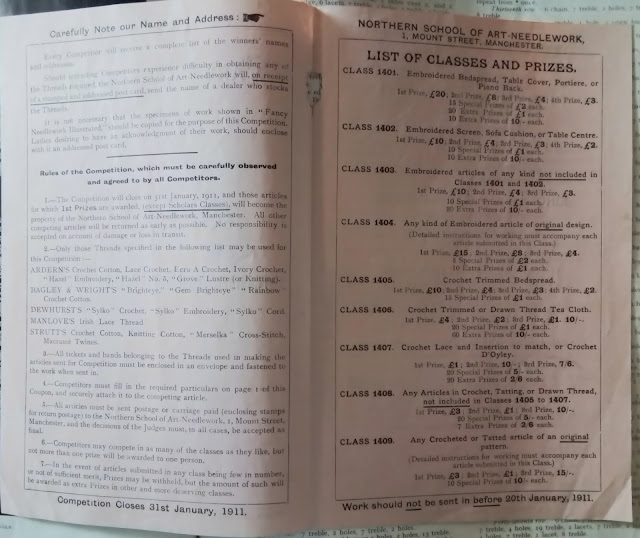
 The magazine 'Fancy Needlework Illustrated' was introduced in around 1906 (the 3rd edition was published in March 1907). It was the official magazine of the Northern School of Art Needlework, Manchester.  It appears that there were very close ties between the School and the English Sewing Cotton Company. I have an issue of the magazine from 1910 and almost every advertisement is for a member company of the ESCC (see below). Also, for some time the School held an annual competition which received wide publicity in contemporary newspapers. Both the launch of the competition and the winners received coverage, with regional publications being especially proud of local prizewinners. The annual contest consisted of several categories, and the sewing cotton to be used in each category was strictly prescribed  - each prescribed cotton being an ESCC product. Here's  a photo of the 1911 competition entry form: Ardern's and Dewhurst's are perhaps the most famous names listed ...

1965 - What Were We Sewing (or not)?

Image
  Woman's Weekly magazine was well known for home-making patterns. Knitting patterns were its forte, but there was always an item of clothing to be sewn too. This 1965 issue leads with a dress to make yourself - using one of their own Fleetway patterns. That they had their own pattern department shows that home dressmaking was not yet out of fashion.  Here's the 1 1/2 page spread inside. Note that they had a partnership with Bentalls to supply the fabric as modelled. It makes it easy and therefore possibly lucrative for both parties.  But then look back to near the beginning of the magazine: Here we have an advert for a bargain buy dress from Etam. According to their website they had just begun selling ready to wear clothes in 1963. It looks to be a simple design, one that a competent dressmaker could probably have a good go at herself. But here they are, taking the bother out of it for not much more cost. Here we have the early evidence of the reason for the ESCC's strug...

Earliest Sylko References

Image
 I have been combing the British Newspaper Archive, looking for the earliest mention of Dewhurst's Sylko cotton thread.  Evidently,  Ardern's Star Sylko nametag preceeded Dewhurst's thread as there are mentions of this earlier on. The Manchester Courier, 9th July 1908, directly refers to "Dewhurst's "Sylko" machine twist" in a report on the Franco-British Exhibition (British Textiles Section). On 13th August 1908, The Tailor and Cutter are also reporting on this exhibition at White City, where Messrs Dewhurst's Sylko machine twist is noticed as being something useful to the Tailor. The wording of both of these articles made me believe that 1908 must have seen the launch of Sylko, as they refer to it as something hitherto unknown. However, I have now found a new reference.  Kentish Express and Ashford News, 26 May 1906 - an advert for Stickells of New Street, Ashford refers to over 90 shades of a silk substitute called "Sylko" "whic...

Hunters Green

Image
  This clipping from The Staffordshire Sentinal dates from 12 December 1928. Under the illustration at bottom left there is a reference to the colour shade Hunter's Green, declaring it to be a new shade.  The Sylko reel Hunters Green is numbered D324. I have seen advertising state that by 1932 there were 300 Sylko shades, so this numbering places it a little after the year of the clipping above. The British Colour Council, with their purpose of helping textile and dye companies to keep up with new colour trends didn't launch until 1931. Dewhurst's late adoption of Hunters Green perhaps demonstrates why the BCC was needed. https://www.etsy.com/uk/shop/SewSylko

Post War Sylko Colours

Image
The British Colour Council continued to operate in the post war period, recommending uniformed colour trends of the coming year in fashion and home furnishings. As I outlined in my blog post about the set up and early years of the council, they particularly came into their own around royal events - or at least the colours introduced to mark these occasions received more prominent press coverage at the time. This trend returned after the WW2 hiatus and into the 1960s, with press reports dropping Sylko enthusiasts a few clues to the years that some of the shades were introduced.  In January 1953, a Leicester newspaper reported on the British Colour Council’s 2 day show in the city. Mention is made of shades introduced to mark Queen Elizabeth's coronation including Elizabethan Red, Princess Grey, Spun Gold and Beau Blue. I haven't seen these colours on a Sylko reel but then the article closes with the following line: "A joyous colour to my mind is Fiesta Pink, as different fr...

The Census in Skipton

Image
 I recently took advantage of a free weekend on one of the genealogy websites to investigate a few families in Skipton.  The first port of call had to be The Dewhurst family, resident at Aireville Hall.  In 1901, the head of the household was 81 year old John Bonny Dewhurst,  grandson of the company founder Thomas Dewhurst and son of the John Dewhurst whom the company was named after. He is listed as being a retired cotton spinner. Also resident at Aireville that cenus night was 49 year old Algernon Dewhurst.  He was the heir to the company and was the first Chairman of the ESCC on its formation in 1897. His occupation is given as Sewing Cotton Manufacturer.  Two of his siblings are also resident  - Frances (45) and Harold (39). Both are listed as being unmarried. Harold is in the family business as a cashier. In the 1911 census, 59 year old Algernon is now the head of the household and is now marked as being retired from the cotton spinning business. ...

Mergers and Name Changes

Image
When the English Sewing Cotton Company began publishing their internal newsletter in January 1966, it counted 21,000 employees. In this first newsletter the company made a statement: "From Monday 3rd January 1966...ESCC will become a holding company and parent company of the following:  1) Textile company to be known as English Sewing Limited 1 which will cover all textile operations   2) UK non-textile companies which will contine to be known under the present titles - Thermo Plastics Ltd, Yates Duxbury Ltd and Lithopak Ltd. 2 3) The overseas companies which will continue to operate under their present names." Notes: 1 - Therefore all Sylko reels labelled English Sewing Ltd date from 1966 onwards 2 - Lithopak was the Hazel Grove manufacturer of ESCC packaging, therefore making the Sylko boxes The locations of the textile company operations were given as follows: Spinning - Portwood, Bolton, Pendlebury,  Lisnaskea, Stanhill Thread - Neilston, Skipton, Belper, Dulwic...

What Were We Sewing in 1958

Image
 I obtained a copy of Needlework Magazine, dating from 1958. On the back cover - this splendid advertisement:  Judging by the wording -"be sure it is genuine" and "accept no other" - there had been a bit of trouble with copycat cotton. I wonder if it is a reference to those Sylvia reels you see knocking about. So let's have a flick through the rest of the magazine - what were we using our Sylkos for in the same year that saw the introduction of motorways, parking meters and the Campaign for Nuclear Disarmament? Here's some of the projects. 1. A picnic cushion bag embroidered with daisies. Something to both carry your magazine and sit upon after your first trip up the motorway. You'd probably want it in green to hide the grass stains so I'm guessing D107 Light Emerald. 2. A three piece towelling beach set - skirt, stole and bag. It's a black and white photo and doesn't suggest colours, but I can see it in a darker yellow. I'm going D21 Gol...

"So No One Will Ever Know You Made it Yourself"

Image
 SO NO ONE WILL EVER KNOW YOU MADE IT YOURSELF. This was a slogan for a 1974 advertising campaign for Trylko. A sad indictment of the way that things were heading for English Sewing - or Tootal by then - in the 1970s. In the early days of Sylko, home made clothes were a matter of fact and a matter of pride. All but the very rich made their own clothes and to have the skill to make something that looked fashionable or stylish was something to show off. But by the time that fast fashion was sweeping the High Street, to make your own clothes was just so square. You wanted to get yourself down to Biba and be groovy, not slave over a Singer. This was an early part of the marketing ramp-up of the closing years of Sylko and Trylko. The above slogan focussed on the quality of the threads - but this isn't enough when people are starting to not want the goods at all. A couple of years later there was a push to get younger people interested in the products with a film and information folders ...